
You are scrolling through YouTube late at night and someone drops a fire track in the comments with a SoundCloud link. You click it, the player loads in your browser, and you are listening to a song that has 847 plays and zero label involvement. That is SoundCloud in its purest form. So what is SoundCloud, exactly? It is an online audio platform where anyone with a laptop and an internet connection can upload, share, and discover music, podcasts, and other audio content without needing a record deal, a publicist, or a studio.
Unlike Spotify or Apple Music, which are built around licensed mainstream catalogs, SoundCloud is built around creators first. That single distinction changes everything about how the platform works, who uses it, and what you actually get on it.
This guide covers what is SoundCloud, how it works for listeners and artists, what the free tier actually gives you, how it compares to Spotify, whether it is safe for younger users, and when using a tool like SoundToMP3.com makes more sense than paying for a subscription.
What is SoundCloud?

A brief history of SoundCloud
SoundCloud was founded in 2007 by Alexander Ljung and Eric Wahlforss in Berlin, Germany. The two Swedish musicians wanted a simple way to share audio files with collaborators. What they built instead became one of the most influential music platforms on the internet.
In its early years, the platform grew into a hub for electronic music producers, bedroom pop artists, and hip-hop acts who could not get traditional label attention. By the early 2010s, it had over 175 million registered users. The company went through significant financial turbulence around 2017, nearly shutting down before being saved by new investment. Today, under CEO Eliah Seton, SoundCloud operates as a profitable platform with a clearer focus on creator monetization and fan engagement.
What started as a file-sharing tool for musicians has become something closer to the YouTube of audio. And like YouTube, its real value lies in the depth of its catalog, not the polish of its app.
What is SoundCloud mainly used for?
At its core, SoundCloud meaning is simple: it is an audio sharing community and social network where people upload and stream music. But in practice, it serves several distinct groups. Independent artists use it to publish tracks they own completely. Listeners use it to discover music they cannot find on Spotify or Apple Music. DJs use it to share mixes. Podcasters use it to host episodes. And in certain scenes, particularly hip-hop and electronic music, SoundCloud is the first place new music appears before it ever reaches a major platform.
SoundCloud rap, the loose genre associated with artists like Post Malone, Lil Uzi Vert, and the late XXXTentacion, literally takes its name from the platform. That is not a marketing claim. It is a cultural fact. Chance the Rapper released Acid Rap on SoundCloud and built a career on it before signing a distribution deal. Billie Eilish started uploading demos to SoundCloud as a teenager. The platform has a real track record of being where careers begin.
How does SoundCloud work?
How to use SoundCloud as a listener

You do not need an account to listen to most public tracks on SoundCloud. Go to soundcloud.com, search for an artist or song, and the player starts. For listeners, SoundCloud functions like a massive open library of audio. You can follow artists, build playlists, and use the discovery features to find music in genres that mainstream platforms under-serve.
The free listening experience is ad-supported, meaning you will hear occasional ads between tracks on the SoundCloud app. On the web, the experience is slightly cleaner.
The music discovery algorithm on SoundCloud leans heavily on genre tags and listener behavior, so the more you interact with tracks, the better your recommendations get over time. This is how SoundCloud free music streaming works at its most basic level, and it is one of the reasons casual listeners rarely feel the need to upgrade.
How to use SoundCloud as an artist or creator
For artists, SoundCloud is one of the most accessible distribution platforms available. You create a free account, upload a track, and within minutes your music is live and shareable globally. No gatekeeping. No approval process. No record deal required. This is the audio sharing community model working as intended.
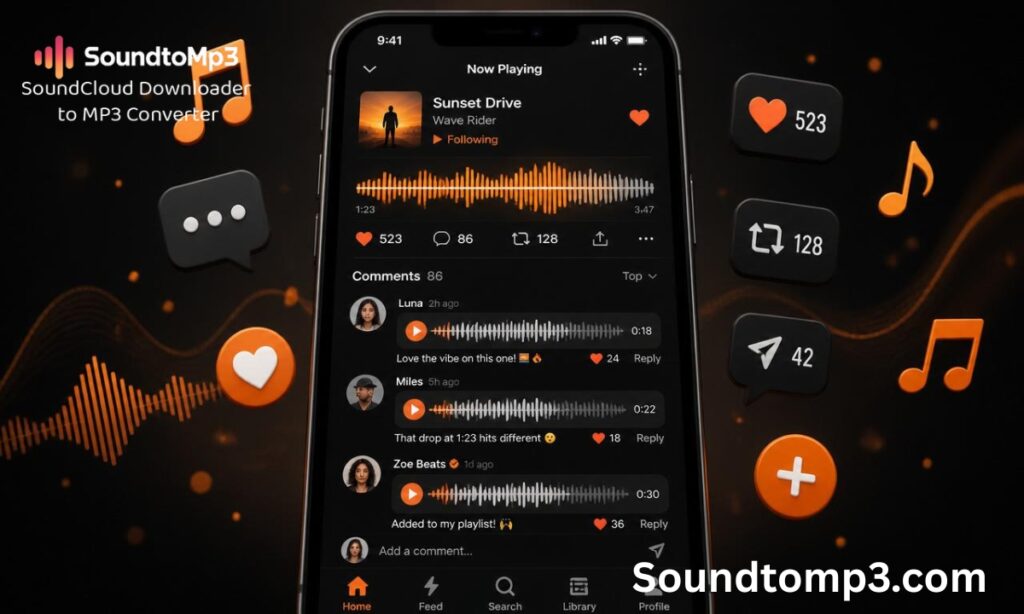
Artists can engage with listeners through comments on individual timestamps in a track, which is a genuinely unique feature. Someone can drop a comment at the 1:47 mark saying “this drop is insane” and that comment appears right on the waveform when others listen. It creates a layer of social context that regular streaming platforms completely lack. Independent artist promotion on SoundCloud often happens organically through these interactions and through reposts, which work similarly to retweets.
How to upload music to SoundCloud
Uploading to SoundCloud is straightforward. You need a free account, then hit the Upload button, drag in your audio file (MP3, WAV, FLAC, AAC, and others are accepted), add a title, tags, artwork, and a description, and publish. Free accounts get up to three hours of total upload time. That is enough for a solid EP or a handful of singles, but it fills up quickly if you are releasing regularly.
Once a track is live, SoundCloud generates a shareable link and an embed code, so you can drop your music on social media, in a blog post, or on your own website without any additional setup. Artists retain full ownership of their content, which is a critical distinction from some other platforms.
Is SoundCloud free?
SoundCloud Free vs. SoundCloud Go vs. SoundCloud Go+
Yes, SoundCloud is free to use, and the free tier is genuinely functional for most casual listeners. You can stream hundreds of millions of tracks, discover new artists, and build playlists without spending anything. That is SoundCloud free music streaming in its most accessible form. The trade-off is ads and the absence of offline listening.
SoundCloud Go is a mid-tier subscription that removes ads and gives access to the full catalog on mobile. SoundCloud Go+ is the premium tier, adding offline listening and higher audio quality at 256 kbps instead of the standard 128 kbps. On a decent pair of headphones, the difference in high frequencies is noticeable, especially on tracks with detailed production. Whether that difference justifies the monthly fee depends entirely on how critically you listen.
| Feature | Free | SoundCloud Go | SoundCloud Go+ |
| Price | Free | ~$4.99/mo | ~$9.99/mo |
| Ads | Yes | No | No |
| Offline listening | No | No | Yes |
| Audio quality | 128 kbps | 128 kbps | 256 kbps |
| Upload tracks | 3 hours | N/A | N/A |
| You own the files | No | No | No |
| Mobile app | Yes | Yes | Yes |
| Exclusive tracks | Yes | Yes | Yes |
SoundCloud for Artists pricing
Artists on the free tier get three hours of uploads and basic stats. SoundCloud Next Pro is the paid artist tier, offering unlimited uploads, advanced analytics, and tools to pitch music to SoundCloud’s editorial team. Pricing is around $2.50 to $8 per month depending on billing period. For a working independent artist who releases consistently, the unlimited uploads alone make it worth considering.
Separate from that, SoundCloud’s fan-powered royalties model distributes money based on how your actual fans listen, not just global stream counts. If someone who subscribes to SoundCloud Go+ listens to your music frequently, more of their subscription fee flows to you specifically. This is a meaningful departure from the pool-based royalty systems used by most other platforms. Artists can enroll through the Repost by SoundCloud program or the Partner program to access monetization.
What SoundCloud Go+ Does Not Tell You

Here is the uncomfortable truth about SoundCloud Go+ offline listening. When you download tracks for offline use inside the SoundCloud app, you do not get MP3 files saved to your phone. You get encrypted cached data that only works inside the SoundCloud app while your subscription is active.
Say you are on a three-week trip through Southeast Asia with unreliable data and you downloaded 200 tracks before leaving. If your SoundCloud Go+ subscription lapses mid-trip because your card gets declined or you decide to cancel, every one of those offline tracks disappears. You own nothing. You cannot move them to another device, import them into a different player, or keep them after canceling. This is not fine print. It is the fundamental nature of streaming licenses.
If what you actually want is a permanent MP3 file of a specific SoundCloud track that you can keep forever, play in any app, and store on any device, SoundToMP3.com is the free tool that handles that. You paste the SoundCloud URL, it converts the track to an MP3, and you download an actual file you own. No subscription required. This is the practical difference between renting access to music and actually having it.
Who Should Pay for SoundCloud Go+
Go+ makes the most sense for listeners who are deeply embedded in SoundCloud’s independent catalog and want the offline functionality for travel or commutes. If the music you care about most, niche electronic subgenres, underground hip-hop, and emerging artists who have not landed on Spotify yet, lives primarily on SoundCloud, then Go+ is a reasonable investment.
It also makes sense for artists who want to support the platform they rely on and benefit from the fan-powered royalties model flowing in the right direction. Paying subscribers generate more meaningful revenue for the independent artists they love compared to free listeners.
Who Should Stay on the Free Tier
Honestly, most people are fine on free. If you listen casually, use SoundCloud to discover new artists and then follow them elsewhere, or primarily use the platform for its unique content rather than as your main music streaming service, there is no reason to pay. That is not a controversial opinion. It is just an accurate read of what the free tier delivers.
If you want specific tracks offline without a monthly commitment, SoundToMP3.com handles that on a track-by-track basis at no cost. That unreleased remix somebody posted three years ago, saved as a real MP3 on your phone for your gym playlist, is exactly the use case it is built for.
SoundCloud vs. Spotify: What is the Difference?

Which is better for listeners?
For mainstream music, Spotify wins clearly. The catalog is larger for licensed commercial releases, the app is more polished, the recommendation algorithms have years of data behind them, and Spotify Premium’s offline downloads work reliably across all devices. If your listening habits center around popular artists and new releases from major labels, SoundCloud vs Spotify is not a close comparison for you as a listener.
Where SoundCloud wins is in depth and authenticity of independent content. If you follow a specific DJ who posts hour-long mixes, if you are into producers who release free downloads, or if you discover music through online communities rather than editorial playlists, SoundCloud’s catalog has material that simply does not exist on Spotify. Both platforms serve different listening habits, and plenty of people use both.
Which is better for artists?
For independent artists early in their careers, SoundCloud is still one of the best distribution options because it has zero barrier to entry and an audience that actively seeks out new music. Spotify requires going through a distributor like DistroKid or TuneCore to upload, which adds a layer of cost and process.
For artists who want maximum exposure and revenue from streams, Spotify is the better long-term platform purely on audience size. But many artists use SoundCloud as the place to test material, share work-in-progress tracks, and build an audience before going wide on other platforms. For artists asking what SoundCloud is in practical terms, the answer is simple: it is your first distribution channel, your demo reel, and your direct line to the most music-hungry listeners on the internet.
Is SoundCloud safe?
Is SoundCloud safe for kids?
SoundCloud is not designed with children as the primary audience, and its content reflects that. There is explicit music, explicit language in comments, and no real age verification system. The platform is technically for users aged 16 and over in most regions, though this is not strictly enforced.
For parents, the honest answer is that SoundCloud is similar to YouTube in terms of content range. There is perfectly appropriate material alongside content that is clearly not meant for young listeners. Parental supervision is the practical solution, not a settings toggle.
SoundCloud parental controls: what you need to know
SoundCloud does not offer parental control features the way some platforms do. There is no family plan, no kids mode, and no content filtering by age. Artists can mark tracks as explicit, and those tracks appear labeled in the app, but there is no way for a parent to block explicit content from an account.
If you are a parent whose child wants to use SoundCloud, the most practical approach is using it together initially, being aware that the discover and trending feeds can surface explicit material, and having a conversation about what content is appropriate. Monitoring through account activity is possible if you have access to the login credentials.
Content guidelines and community rules
SoundCloud prohibits content that infringes on copyright, includes hate speech, or promotes violence. The platform has a DMCA takedown process for rights holders and a reporting system for community violations. In practice, enforcement is uneven, as it is on most large platforms. Bootleg remixes, unofficial edits, and tracks that sample unlicensed material exist in large quantities and persist until a rights holder files a complaint.
For creators, this means understanding that tracks can be taken down if they contain unlicensed samples. For listeners, it means that a track you love today might disappear tomorrow. This is another reason why converting and saving tracks you care about is a practical choice.
The SoundCloud app: features and availability

SoundCloud on mobile (iOS and Android)
The SoundCloud app is available on iOS and Android and functions as the primary way most people access the platform outside a desktop browser. The mobile app supports streaming, playlist management, track comments, and offline playback for Go+ subscribers. The interface has improved significantly over the years, though it still lags behind Spotify and Apple Music in terms of visual polish and navigation speed.
One thing the mobile app does well is the waveform player with timestamp comments visible during playback. It is a feature that sounds minor until you use it and realize how much context it adds to listening. Hearing people react to a specific moment in a track in real time, even in text form, changes the experience in a way that is hard to replicate.
SoundCloud Go: offline listening explained
As covered earlier, SoundCloud Go+ offline downloads are app-locked encrypted files, not portable MP3s. They work exactly like Netflix downloads: convenient inside the app, useless outside of it. If your subscription is active and you have the app installed, offline tracks play. Cancel the subscription and those files stop being accessible.
This architecture is intentional. SoundCloud, like every other streaming platform, licenses music rather than selling it to you. Offline playback is a feature of your subscription, not a file transfer. Understanding this distinction helps you decide whether Go+ is actually useful for your specific situation.
Is SoundCloud worth using in 2025?
Yes, and the answer is even clearer if you care about independent music. No other major platform gives independent artists the same zero-barrier access to a global audience while also offering listeners access to that full catalog for free. SoundCloud has survived financial crisis, platform shifts, and the rise of Spotify, and it remains the most important platform for early-stage music careers in multiple genres.
The free tier is genuinely good for casual listeners. Go+ makes sense for heavy users who are embedded in SoundCloud’s specific catalog. And for anyone who just wants specific tracks offline permanently, SoundToMP3.com provides a free and practical alternative to a monthly subscription commitment.
How does SoundCloud work as a total platform in 2025? Better than its reputation suggests, with a more stable business model, creator-first royalties, and a catalog that major platforms still cannot replicate.

Frequently asked questions about SoundCloud
Is SoundCloud free to use?
Yes. SoundCloud has a functional free tier that lets you stream music, follow artists, and build playlists without paying anything. Ads are present on the free tier. SoundCloud Go and Go+ are paid subscriptions that add offline listening, ad removal, and higher audio quality, but free access to the core platform is unlimited. SoundCloud free music streaming is one of the most accessible ways to discover independent artists without any cost.
Is SoundCloud legal?
SoundCloud as a platform is fully legal. The company is licensed to distribute music and operates under standard copyright law. Individual tracks on the platform may or may not be legally uploaded, since some artists post material that includes unlicensed samples or covers. SoundCloud has a DMCA process for handling takedown requests. Using the platform itself is legal. Whether a specific track is legally cleared depends on what the uploader has done, which is outside SoundCloud’s immediate control.
Who owns SoundCloud?
SoundCloud is a private company headquartered in Berlin, Germany, with additional offices in New York. The major investors include SiriusXM and Raine Group, who invested in 2020 to help stabilize the platform after years of financial difficulty. Eliah Seton serves as CEO. The platform is not owned by Spotify, Apple, or any major label, which is central to its identity as an independent-artist-first platform.
How does SoundCloud pay artists?
SoundCloud pays artists through its fan-powered royalties model, which is different from the pool-based model used by Spotify. When a Go+ subscriber listens to your music, a portion of their subscription fee is allocated specifically to the artists they listen to, meaning a dedicated listener has more financial impact on your payout than a casual one. Monetization requires enrolling in the Repost by SoundCloud program or the Partner program. Free-tier listener streams generate lower royalties than Go+ subscriber streams.
What is the difference between SoundCloud and Spotify?
The core difference is catalog origin. Spotify’s catalog is primarily licensed from major and independent labels. SoundCloud’s catalog is primarily uploaded directly by individual artists. SoundCloud vs Spotify comes down to this: SoundCloud has exclusive content that does not exist on Spotify, including demos, free releases, DJ mixes, and tracks from artists who have not signed any distribution deals. Spotify has a larger mainstream catalog, better app performance, and more refined recommendation algorithms. Many music fans use both for different purposes.
Can you download music from SoundCloud for free?
Some artists enable free downloads directly on their tracks, which lets you download an official file they have chosen to share. For tracks without free download enabled, SoundCloud’s own offline feature requires a Go+ subscription and locks files inside the app. If you want an actual MP3 file of a public SoundCloud track that you can keep permanently, SoundToMP3.com is a free converter where you paste the URL and download the file. The result is a real MP3 you own, not an app-locked cache file.
Is SoundCloud safe for kids?
Not by design. SoundCloud does not have parental controls, a kids mode, or effective content filtering. Explicit music is common and labeled but not blocked. The platform is formally for users 16 and older. Parental supervision is the practical solution for younger users who want to access the platform, particularly given the comment sections and trending content that can surface explicit material without warning.
Conclusion
What is SoundCloud? It is the most honest answer to the question of where music actually comes from before it reaches the mainstream. It is a platform built for creators first, listeners second, and the mainstream music industry a distant third. That hierarchy is both its greatest strength and its occasional limitation.
If you are a music fan who cares about discovering artists before the algorithm finds them for you, SoundCloud is worth your time on the free tier. If you are an artist who wants to share your work with the world today, with no approval process and full ownership of your content, SoundCloud is still one of the best tools available. And if you want specific tracks saved permanently as files you actually own, SoundToMP3.com gives you that option without a monthly commitment.
The platform has come a long way from a Berlin apartment where two musicians wanted to swap audio files. In 2025, it is still the most direct connection between an independent artist and a stranger who might love their music.
